Role
Team Lead, Team 7009X
Six-plus years leading a world-ranked competitive VEX robotics team, writing the real-time C++ that makes a robot score on its own, and routinely out-placing far larger, older programs.
I lead a 2-person, all-underclassmen team that competes at the top of VEX Robotics. We qualified for the VEX World Championship in multiple seasons and reached the Division Finals out of 834 teams (Worlds, Dallas, 2025).
I own the full 9–12 month season: design, fabrication, programming, autonomous routines, and a 200–600 page engineering notebook that has won top judged awards. The engineering writing matters as much as the robot, it's how you prove your process to judges.
On the software side, I implement PID and odometry motion control in C++ for precise autonomous scoring. That work is behind the team's Think Award, the highest programming award at the Georgia State Championship.
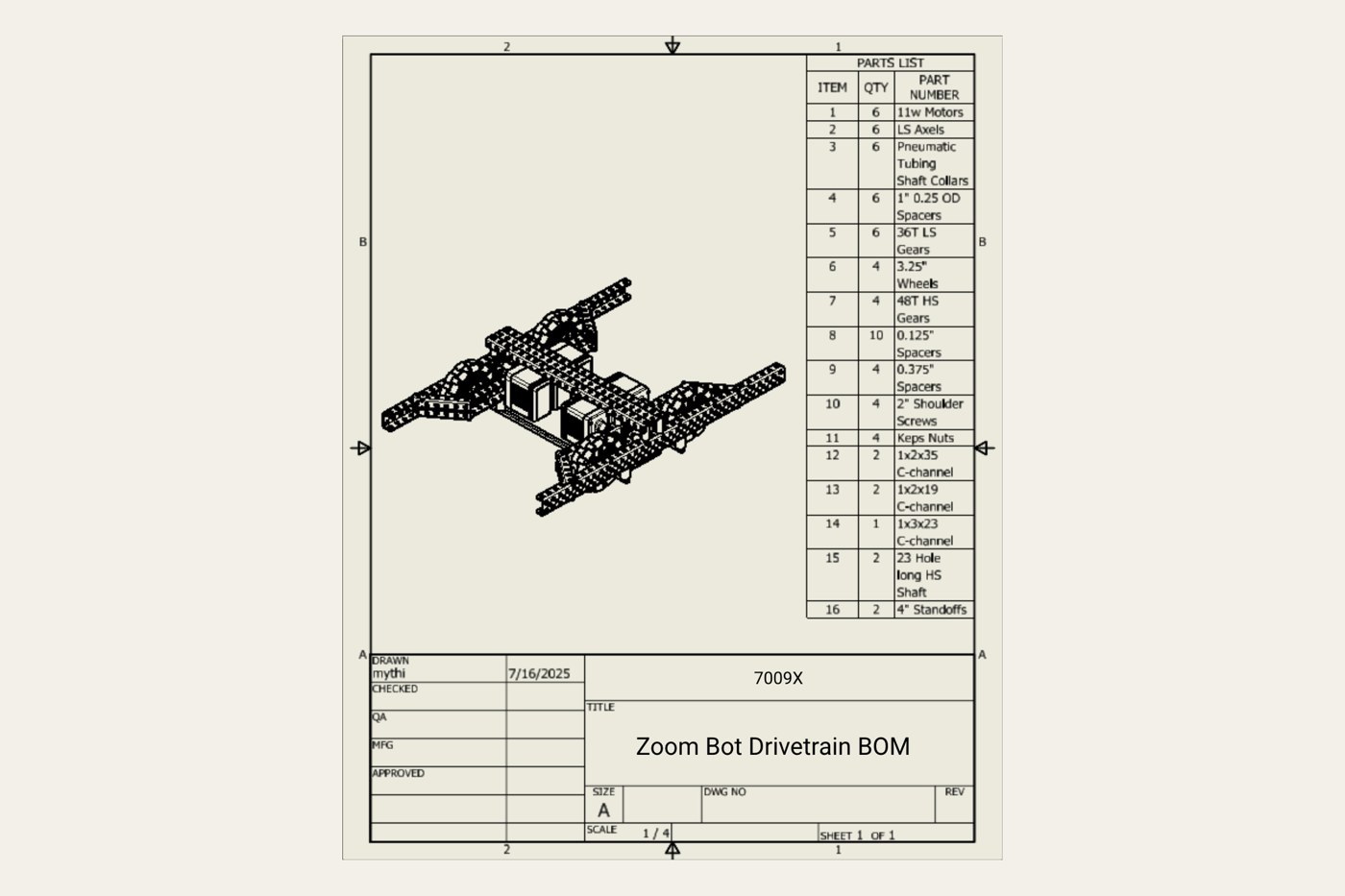
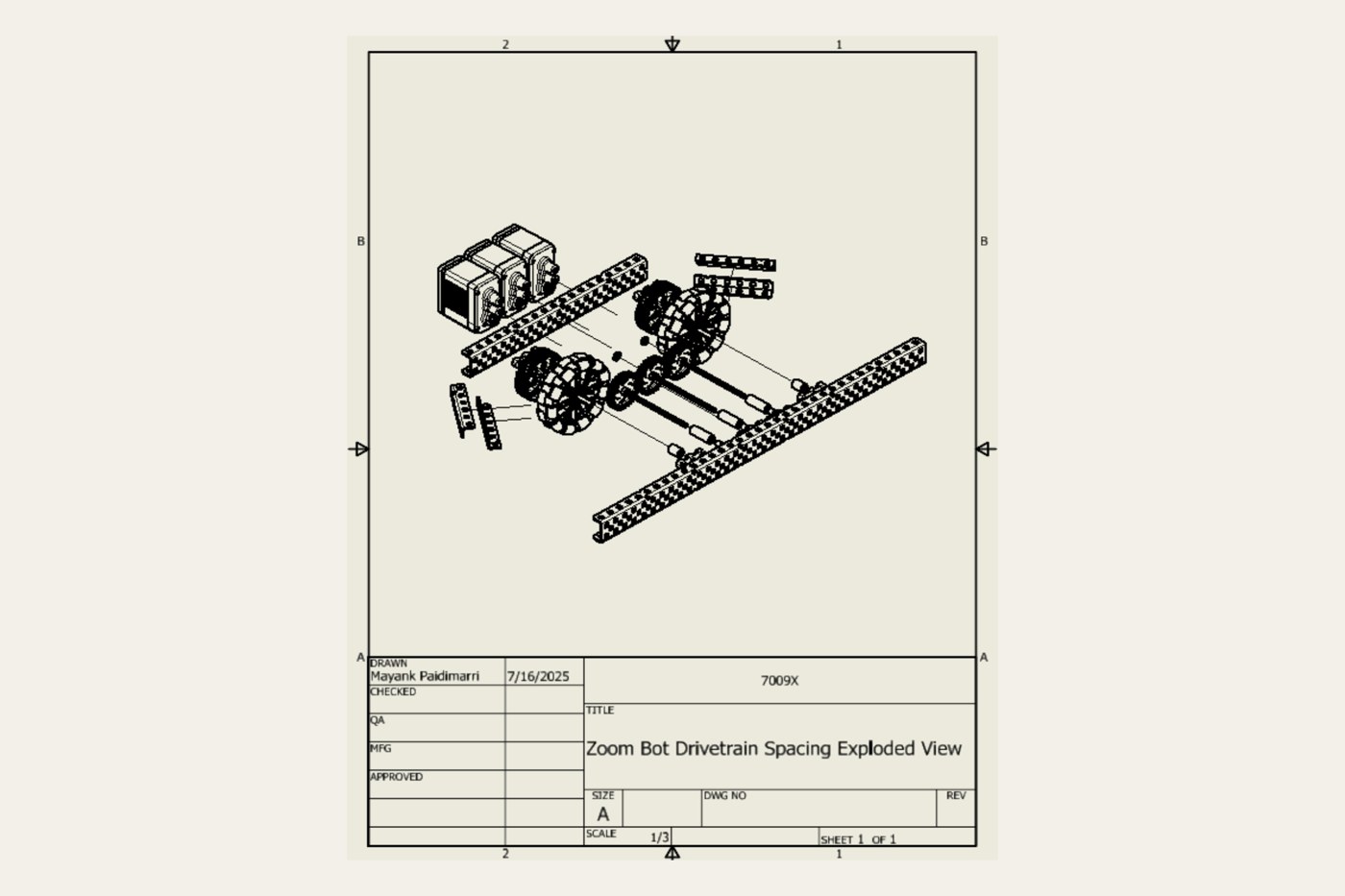
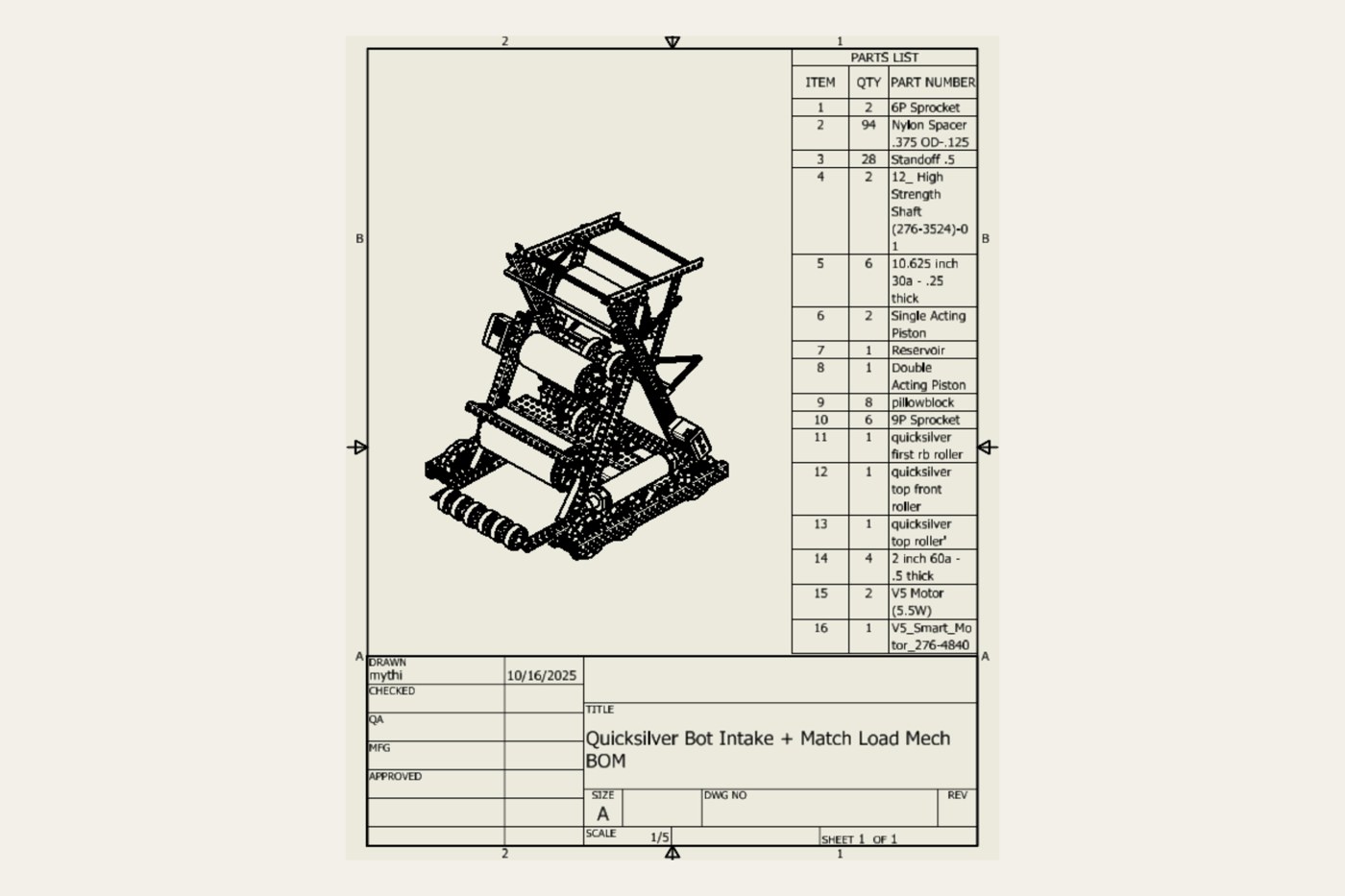
Every robot starts as a full CAD model and a documented bill of materials before a single part is cut. These are drawings straight from our design files.
The autonomous period is fifteen seconds where the robot runs entirely on its own code. Getting it to score reliably comes down to two things: knowing where the robot is, and controlling how it moves there.
Odometry tracks position in real time. Tracking wheels feed encoder counts into math that continuously updates the robot's (x, y, heading) on the field, so it always knows where it is rather than guessing from time or motor power.
PID control turns a target into smooth, accurate motion. Instead of driving full speed and overshooting, the controller corrects continuously off the error between where the robot is and where it should be, so it decelerates into the exact position. The same loop drives both the wheels and the mechanisms.
That control work is what earned the team's GA State Think Award, the event's highest programming recognition.
A VEX season runs nine to twelve months and ends in a handful of two-minute matches, so every decision has to converge on a date that does not move. There is no extension and no patch after the fact. The robot either works on the field or it does not.
Alongside the robot I keep a 200 to 600 page engineering notebook that records every design decision, test, and revision. Judges read it to understand the process behind the build, and it is how the team has won top judged awards. The writing is not an afterthought; documenting why a choice was made is part of making a better choice.
Leading a two-person, all-underclassmen team means I own design, fabrication, programming, and documentation at the same time, against programs many times our size and several years older. That constraint is the whole point: it is where I learned to ship.
Reached the division finals at the largest stage in VEX, against far larger and better-resourced programs.
The Think Award recognizes the strongest programming and engineering process, driven by the autonomous C++ control work.
Also Division Semifinalist among 150 teams (2025).
Won the high-school challenge at a major industry automation conference.
Sustained results across multiple seasons and game formats.
Robotics is where I learned to ship under hard constraints. There's a fixed weight, a fixed size, a fixed deadline, and a real match where the robot either works or it doesn't. You can't talk your way out of a failed autonomous routine.
Writing PID and odometry from the math up, not from a copied template, is the reason control systems and real-time code feel natural to me now. Software, cryptography, and robotics are the same discipline to me: model the world honestly, then make something do the right thing reliably.